What Is Google Consent Mode?
Collecting data in the world of digital analytics gets harder by the day. As privacy regulations (KVKK, GDPR) tighten, data loss has become unavoidable for analysts.

Collecting data in the world of digital analytics gets harder by the day. As privacy regulations (KVKK, GDPR) tighten, data loss has become unavoidable for analysts. Google Consent Mode is the technical layer that closes this data gap while keeping you privacy-compliant.
What Is Google Consent Mode and What Is It For?
Google Consent Mode is the system that governs how the Google tags on your website (GA4, Google Ads) behave dynamically according to your users' cookie preferences.
What is it for?
Instead of cutting the data flow off entirely when a user does not give consent, it sends anonymous signals ( pings) that contain no personal data. It lets analysts and marketers make up for the data loss with machine learning models ( Conversion Modeling).
How Does Consent Mode Work?
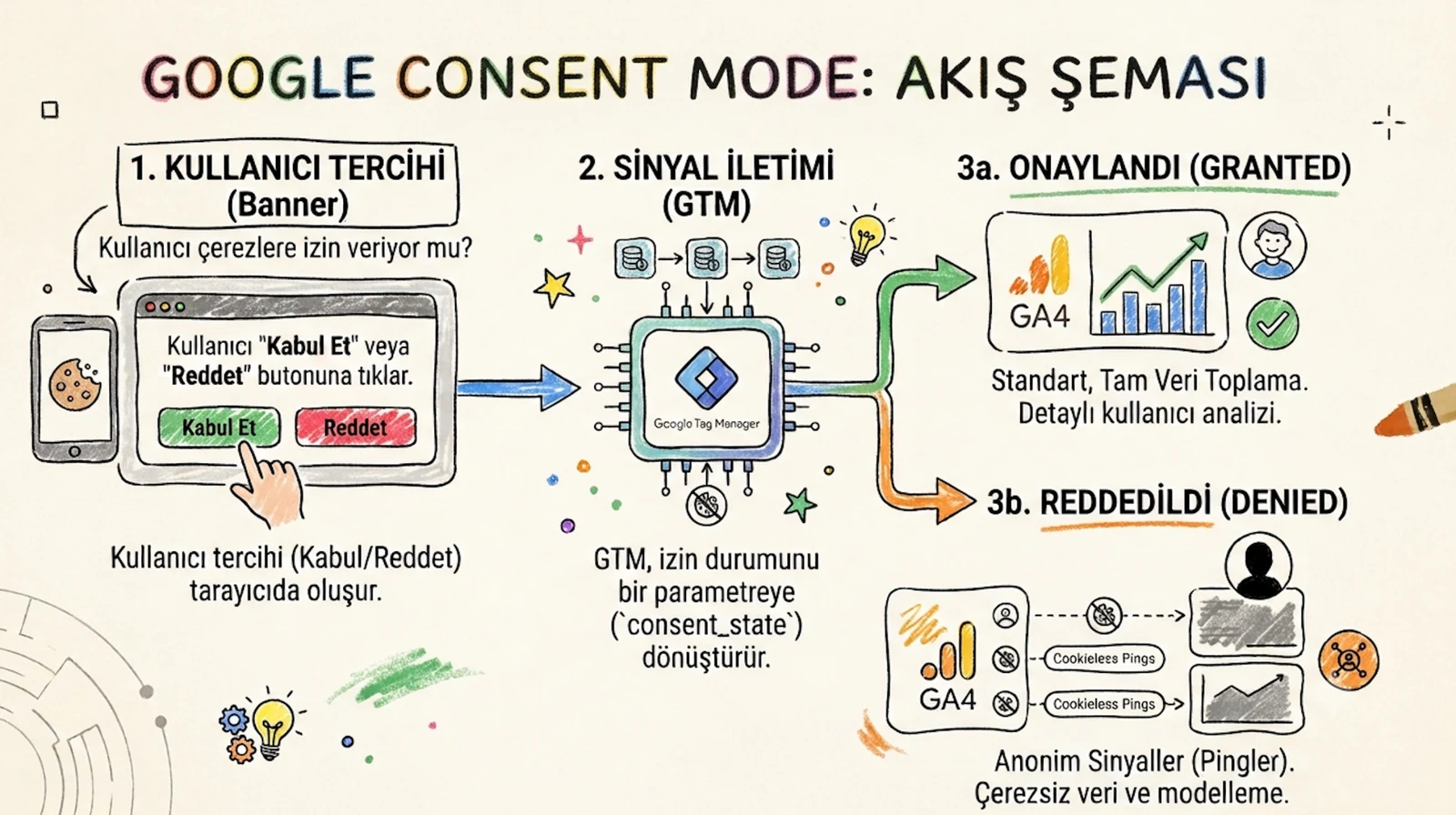
Consent Mode builds a communication bridge between the cookie consent banner (CMP) on the site and the Google tags.
How Is the User's Preference Captured?
When a user arrives on the site, they are met with a cookie banner. The preference expressed by clicking "Accept" or "Decline" is captured in real time.
What Is the Default Consent State?
It is the default consent status defined the moment the page loads. To prevent a data breach, the default state is set to declined ( denied) when the system starts.
How Does Consent Update Work After the User's Choice?
When the user gives consent, the system automatically sends an update signal. The consent states are updated to granted ( granted) and the tags switch to standard data collection mode.
Does Consent Mode Replace a Cookie Banner?
Consent Mode is not a cookie banner. It does not provide the interface shown to the user. It only reads the consent signals coming from your existing banner and passes them to the Google tags. It has to be used together with a Consent Management Platform (CMP).
What Is Consent Mode v2?
Google announced Consent Mode v2 in March 2024. Two new privacy parameters were added compared with the previous version. In digital marketing markets, v2 has become mandatory in order to measure advertising at all.
What Is ad_storage?
It allows advertising cookies (Google Ads conversion tracking, for example) to be written to and read from the browser.
What Is analytics_storage?
It allows analytics cookies (GA4 visitor and session tracking, for example) to be used.
What Is ad_user_data?
It determines whether the user's personal data (email, phone, and so on) may be sent to Google for ad targeting.
What Is ad_personalization?
It allows user data to be used for remarketing ( remarketing) and personalised advertising.
What Are the Consent Mode Parameters?
These are the core parameters used in analytics and tag management:
ad_storage: Consent to store advertising cookies.
analytics_storage: Consent to store analytics cookies.
ad_user_data: Consent to send personal data for advertising.
ad_personalization: Consent for remarketing and personalised ads.
functionality_storage: Consent for language and preference cookies.
personalization_storage: Consent for content personalisation.
security_storage: Consent for security and verification cookies.
Which Google Products Does Consent Mode Affect?
Google Ads (Search, Display, Remarketing)
Floodlight (Display & Video 360, Search Ads 360)
Google Tag Manager (tag firing rules)
How Does Consent Mode Affect Other Marketing Tools (Meta, TikTok, etc.)?
Although Consent Mode technically belongs to Google's infrastructure, from an analyst's point of view it governs the entire marketing ecosystem:
Meta, TikTok, LinkedIn pixels: Because the triggers in GTM are tied to Consent Mode signals, these pixels are blocked when consent is declined.
User experience tools (Hotjar, Clarity): When analytics consent is not given, session recording and heatmap tools are stopped.
Cross-channel attribution balance: While GA4 models the missing data, the other panels can be left with none. This is a critical balance that data analysts need to keep in mind when optimising budgets.
How Does Consent Mode Affect GA4 Data?
Anonymous signals are sent to GA4 for users who decline cookies.
Behavioral Modeling ( Behavioral Modeling): GA4 processes the anonymous signals and uses AI to estimate the behaviour of users who declined.
Report completeness: 60-70% of the lost visitor data is recovered in the panels.
How Does Consent Mode Affect Google Ads Measurement?
Conversion Modeling ( Conversion Modeling): The conversions of users who do not consent are modelled from anonymous signals.
Bidding algorithms: Smart Bidding ( Smart Bidding) strategies keep optimising without being affected by the data loss.
Is Consent Mode Mandatory?
The v2 setup is mandatory for every business reaching users in the European Economic Area (EEA) or using audience/remarketing lists in Google Ads. Without it, remarketing audiences stop refreshing.
Frequently Asked Questions
1. What happens if Consent Mode v2 is not integrated?
Your Google Ads remarketing lists stop filling, your audience size drops to zero and your ad performance falls.
2. Is using Consent Mode enough on its own for KVKK and GDPR?
No. Consent Mode is an infrastructural transmission mechanism. For legal compliance, an approved cookie banner (CMP) and a privacy notice are mandatory.
3. When a user declines cookies, does no data reach Google at all?
No — anonymous signals ( pings) containing no personal data or cookie identifiers are still sent. These signals are not used to track individuals, only to model aggregate numbers.